I wonder how many other people after watching the entertaining Fry's Planet Word on BBC on Sunday, were left with the same question as me: when does a series of grunts move from being 'just' communication to being a language?
Fry argued, as many before him have, that it is language which sets humans apart from other animals. And, indeed, uniquely on this planet, we appear to have genes specifically geared towards making language acquisition a natural process, as well as the specialised vocal apparatus.
But what is language? Our nearest cousins in the primate world communicate with each other, and can be taught to use symbols which communicate with us. However, this is not language, according to Fry, because it is merely responding to an immediate emotion or need in the present moment.
So, in that case, when I request a glass of water or say, 'I'm scared', have I dropped from the pinnacle denoted as 'language' to the base 'communication'?
Wednesday

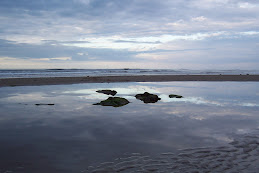
While at the Lapidus (http://www.lapidus.org.uk/) agm the other weekend, I attended a writing workshop facilitated by Vicky Field. We were exploring the idea of islands and afterwards I did one of my cartoons in my writing journal. It is the first time I have put one of my sketches on public view!
I am really enjoying seeing where my visual creativity can take me and how it complements or enhances my writing.
It is interesting that we tend to categorise ourselves in one art form or another, and yet, I'm beginning to feel, this is a false pigeon holing. There are famous examples of those who were wordsmiths as well as artists, such as William Blake, and less well known ones, for instance Daphne Du Maurier painted when she was blocked in her writing.
I heard Kwame Kwei-Armah say on the radio some time ago that in this country we distrust people who want to branch out into many art forms. It's a shame if this were true, since, I believe, the blossoming of one aspect of our creativity helps the fruition of another.


Found Poetry
I've just visited London, a place I lived on the edge of for some years, but never felt at home in. Going to pick up a tube map at Kings Cross, I found instead a similarly configured leaflet entitled 'Polish Poems on the Underground'.
What a trove. One poem, in particular, spoke to me immediately:
I returned to you years later,
gray and lovely city,
unchanging city
buried in the waters of the past.
I'm no longer the student
of philosophy, poetry, and curiosity,
I'm not the young poet who wrote
too many lines
(Extract from Star by Adam Zagajewski, trans Clare Cavanagh)
I've just visited London, a place I lived on the edge of for some years, but never felt at home in. Going to pick up a tube map at Kings Cross, I found instead a similarly configured leaflet entitled 'Polish Poems on the Underground'.
What a trove. One poem, in particular, spoke to me immediately:
I returned to you years later,
gray and lovely city,
unchanging city
buried in the waters of the past.
I'm no longer the student
of philosophy, poetry, and curiosity,
I'm not the young poet who wrote
too many lines
(Extract from Star by Adam Zagajewski, trans Clare Cavanagh)
While gazing at my four season collages, an artist friend said, and when you look at them, doesn't it take you back to the moment you made them?
I gave a non-committal reply as that didn't quite fit for me. On the other hand, delving back into my writing journals, as I have been doing recently, certainly allows me to time travel. Seeing my words and the way they are formed - the size and consistency of the letters - on the paper, tells me a great deal about how I was feeling at the time.
I've been discussing whether it is possible to keep a reflective writing journal on line. Perhaps for some it is. However, I wonder whether the technology not only means that the writing loses its spontaneity, that 'before the thought is fully formed' quality, but also the visual impact of how it was written when reading back.
In my journals I've been finding titbits to inspire my present writing projects. I also re-discovered this which I still like as a meditative little piece:
Those moments I lost
in the pettiness of things,
I find again in the sea's
underwater calm.
Those moments I lost
in the fear of things,
I find again in the sea's
night terrors.
Monday
I love to sit at the top of our garden by our lavender bushes and watch the indsutry of bees. I am humbled that they put so much effort in and, over their lifetime, produce just a tea spoon of honey. I wonder what my tea spoon of honey will be?
Bee Keeper
Today I feel the weight of honey,
the deliberateness of bees.
I sip my lavender cup
then slip to the next,
through draped cherry skirts,
my bloomers pollen yellow,
with a certainty and a fecundity
insects know
and humans have lost.
I will have my portion of nectar today,
create my share of sweetness.
Bee Keeper
Today I feel the weight of honey,
the deliberateness of bees.
I sip my lavender cup
then slip to the next,
through draped cherry skirts,
my bloomers pollen yellow,
with a certainty and a fecundity
insects know
and humans have lost.
I will have my portion of nectar today,
create my share of sweetness.
Tuesday
My mind goes back to the International Human Sciences Conference which I attended in July. One of the keynote speakers was Professor Bernd Jager from the University of Quebec. He spoke about creation myths and how they might be used to understand (rather than explain) aspects of our shared humanity.
He suggested some commonalities in these myths: action followed by encounter, then a 'standing back' and a 'calling forth' of what has been created. This is followed by a benediction, a 'seeing that it was good'.
And I thought that it is often the 'benediction' which I forget, the moment (in Gestalt terms) of satisfaction, when the desire has been fulfilled. Perhaps that's why sometimes I feel like a hamster on a wheel.
Jager talked about the importance in myth of the rhythmic succession of 'creation' followed by 'benediction' and 'rest'. I wonder if there is something unhealthy in having lost this sequence.
He suggested some commonalities in these myths: action followed by encounter, then a 'standing back' and a 'calling forth' of what has been created. This is followed by a benediction, a 'seeing that it was good'.
And I thought that it is often the 'benediction' which I forget, the moment (in Gestalt terms) of satisfaction, when the desire has been fulfilled. Perhaps that's why sometimes I feel like a hamster on a wheel.
Jager talked about the importance in myth of the rhythmic succession of 'creation' followed by 'benediction' and 'rest'. I wonder if there is something unhealthy in having lost this sequence.
Subscribe to:
Posts (Atom)