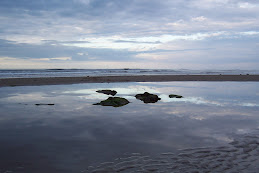
Monday


Winter Solstice
Compass of the waves -
sombres season's conductor
to the sun's return.


Saturday

My article "The poetry of therapy" has appeard in Therapy Today's current issue!
http://www.therapytoday.net/article/1/45/categories/

Wednesday

In the bleak mid-winter
Frosty wind made moan,
Earth stood hard as iron,
Water like a stone;
"A Christmas Carol" by Christina Rossetti

This was one of my favourite carols to sing at the service we attended at Durham Cathedral each Christmas Eve when I was a child. I was always disappointed if it came up in the programme as "choir only".

It took me twenty years to discover that the words had been written by one of the few pre-1950s British female poets who ever make it into "best loved" or "classic" anthologies.

It feels, more than ever, that we are in a bleak mid-winter. Debt, economic crisis, massive wealth inequalities, climate change, animal and resource over-exploitation, species loss, human suffering, the list falls like the snow in Rossetti's poem. And the only answers offered are: consumerism, a "me first" attitude to rights and war. It seems the last part of the carol is missed:

"What can I give Him.
Poor as I am?
....
Yet what I can I give Him.
Give my heart."

As a child I would fill with tears singing those lines. As an adult who does not believe in a "Him", I replace Rossetti's word with "the world" and I still feel like weeping.

A word which is appearing more and more often in our sore times is "efficiency". We will get through this bleak "blip in our prosperity" by being more efficient. What is disregarded is that as humans we are not made to be efficient, and, indeed, the moments when we are least efficient are when we are the most human. The health professional who sits with the elderly woman for five minutes, perhaps holding her frail hand, and listening, to a long drawn out story which is confused and has nothing to do with the "presenting problem", is not being efficient. Yet would we want to be without these moments of connection?

Being efficient also squeezes out creativity. Our creativity relies on having the time to day dream, to play, to explore without direction and to make mistakes. These are not activities which sit easily along-side "efficiency".

I would propose less efficiency. Yes, perhaps we will have to do without as many things, wait longer for responses, put up with more glitches in the system. On the other hand, would we not feel compensated by the nurturing of relationships and the gifts of creativity?

Monday

When I was about thirteen my art teacher told me I was rubbish at his subject. And I believed him for a very long time, still do in some ways. However, over the last few years, I have been exploring collage, using torn up paper, found items, oil pastels, felt tip pens and watercolour. More recently I've been combining this with my poems.

I enjoy the process of writing and then seeing it visually before creating the poetry-collage. I've had some good feedback now that I've tentatively started to show the reseults to a trusted few. But is it art?

I've had no training since those torturous classes at school. I can't draw anything which looks like anything in reality. Yet I have a sense of form and colour and produce pieces which do have impact. Is that art?

There's a BBC2 series on at the moment, School of Saatchi - reality TV for the pretentious as a student of mine put it - which follows a number of unknown contemporary artists through different set tasks, the prize being the patronage of Charles Saatchi. One of the questions artist Tracey Emin, and some of the other judges keep asking is: "but is this art?"

And sometimes that query whispers in my brain as I sit down to work on another collage. Then I think, does it matter? Maybe not, I comfort myself. Yet, I do think the discussion, is this poetry? a valid and an important one, so perhaps I am letting myself off the hook too easily.

Wednesday

Keats wrote that hope is a healing balm, a shining star, yet some become paralysed when trying to write about it. For others, Keats's words remind them how little hope there is, or has been, in their lives and this leads to sadness, anger, depression. When I offer writing about hope to my therapeutic group, I am reminded of this once again.

Hope
is a sparkling cloud in the clear blue.
Patiently it takes on the shape
of a flower, or a bird,
or a loved one,
whatever we need to see.

But is it no match to stormy weather
pulling the shutter across.

Tuesday


Sea Creature
The last time I came, there were fisherfolk here and nets,
the smell of fish, fresh and drying.
It was Summer. It would have been Summer.
I watched the red lobster pots being tossed from small boats.
I came out of the sea, a harvest of kelp draped across my back,
salt encrusting my lizard skin as the water dried.
I had not drowned as the legend said.

Why should I have done?
I have the lung capacity of a whale.
I had spent years upon years laid out on the icebergs, waiting for death.
It did not come. Why should it?
A life force like mine would see death itself perish.
So I knew I would find my way home.

Only I was weak after so many decades of the cold and the white.
I gorged myself on turtles and sea lions and bears
before submitting to the womby waves.
I followed the silver lightship through the sea's midnight,
an ocean of memories spun out before and behind
leading me to this one beach.

Here once, long ago, we scribbled and scrabbled,
two rabbly creatures,
birthed, then cribbed, then torn apart.


Monday

I have been running therapeutic creative writing workshops for people with depression and anxiety for about six years now. I enjoy the work, particularly the diversity of people that I come to meet and the journeys we take together. However, my experience over this time has brought me to question more and more the funding of mental health services.

Mental health provision has been called the "Cinderella" services, left behind in terms of money and commitment because of the stigma attached to mental ill-health. More recently the government pledged £173 million to improve access to psychological therapies on the NHS in England. This funding was announced in 2007, to be rolled out during the three years until 2010. Now, though, there appears to be a question mark over whether this money is "ring-fenced" or whether, as the public purse gets squeezed, it can be syphoned off to other services.

Often governments behave as though there isn't a table of priorities when it comes to spending, but, of course, there must be since budgets cannot be finite. And what I see happening is that paying for expensive drugs or treatments to prolong people's physical health is far more popular than committing resources to improving people's mental health.

I believe that "mental illness" are still seen as dirty words, something not quite acceptable in our society. Add to that the tendency to suggest that those with mental health issues should really just be able to "pull themselves together" - even though those with physical illnesses are not expected to heal themselves - and the undermining media image of those who suffer from psychological problems, and no wonder mental health services are so poorly supported.

I am glad when what I offer - two hours of creative writing a week - can help people to face their lives with greater purpose. However, I am deeply saddened when I see that it is the only substitute for services which ought to be - but are not - there.