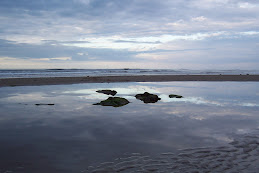
I have to admit to not feeling much like writing this evening. Things have suddenly got very busy in all departments of my life and I feel tired. Yesterday the bright spot was the first session in the Creative Writing for Good Mental Health course (funded by the WEA). Ten of us gathered and began to get to know each other and plunge into the enthralling (to me, at least) technique of free writing. It is interesting that some people take to this throwing off of "shoulds" and rules with enthusiasm and some are more guarded. It is difficult to know, sometimes, how to give people the permission to "just let it flow" when they are used to so many "rights" and "wrongs".
Today the bright spot was an email from my collaborator, Matt Barnard, on my Edith Sitwell installation, 'Words in My Head'. I do find it exciting to be working with someone else, whose skills and talent (in this case in terms of composing and music tech) can take my words and poetry into a place and direction that I am not even able to conceive of.
Apart from that, the volume of work and number of things to be taken into account at this present time, make the days challenging and the nights restless. I went swimming at lunchtime and found myself in the fast lane being splashed and edged out by big muscular men intent on front crawling as fast as they could from one end to the other with little regard of who might be in the way. Felt a bit like a metaphor.
Tuesday
War, what is it good for? Absolutely nothing! Say it again. So sang 'Frankie Goes to Hollywood' in the 1980s and I danced around to it as a student, believing every word. Believing if I shouted it loud enough, there would be no more war.
And yet it seems to be everywhere at the moment. The present wars and the agonisingly poignant stories of soldiers coming back as multiple amputees and/or deeply emotionally and psychologically traumatised. The past wars in the many anniversaries to do with WWII, and interviews or images of those involved still grieving after over 60 years.
A statistic stood out for me this week, I can't remember it exactly, it was something like 100 years ago 95% of the casualties of war were combatants, now 95% of casualties are civilians.
War is good for nothing. We sing it, we know it and yet we don't seem to be able to live it.
And yet it seems to be everywhere at the moment. The present wars and the agonisingly poignant stories of soldiers coming back as multiple amputees and/or deeply emotionally and psychologically traumatised. The past wars in the many anniversaries to do with WWII, and interviews or images of those involved still grieving after over 60 years.
A statistic stood out for me this week, I can't remember it exactly, it was something like 100 years ago 95% of the casualties of war were combatants, now 95% of casualties are civilians.
War is good for nothing. We sing it, we know it and yet we don't seem to be able to live it.


My friend and colleague, Hazel, and I facilitated our first Writers' Way residential at Cober Hill this weekend.
We aimed to offer an exploration of creativity through guided writing exercises, meditation and visualisations. We began on Friday afternoon, and the first session, as so often is the case, was a little shaky with everyone nervous and some people very tired from stressful working weeks or long journeys. However, as we went along, everyone grew in confidence and the group gelled to be supportive and inspirational. I was buoyed up by the positive creative energy which was swirling around.
Cober Hill (http://www.coberhill.co.uk/) is also such a gorgeous setting to hold a residential, with its gardens and walks all the way down to the sea. A perfect place to awaken all our physical senses and feel grounded in our bodies whilst allowing our imaginations to take flight.
The finest feedback to receive from the participants on the Sunday as we parted was a call for a five day course. A sign that what we'd succeeded in bringing about had indeed been useful and nourishing to people.
We aimed to offer an exploration of creativity through guided writing exercises, meditation and visualisations. We began on Friday afternoon, and the first session, as so often is the case, was a little shaky with everyone nervous and some people very tired from stressful working weeks or long journeys. However, as we went along, everyone grew in confidence and the group gelled to be supportive and inspirational. I was buoyed up by the positive creative energy which was swirling around.
Cober Hill (http://www.coberhill.co.uk/) is also such a gorgeous setting to hold a residential, with its gardens and walks all the way down to the sea. A perfect place to awaken all our physical senses and feel grounded in our bodies whilst allowing our imaginations to take flight.
The finest feedback to receive from the participants on the Sunday as we parted was a call for a five day course. A sign that what we'd succeeded in bringing about had indeed been useful and nourishing to people.
Earlier in the Summer I heard that I had the "commission", along with a small budget, to do an art installation for Coastival next February (www.coastival.com). Words in My Head (which was meant to be a working title but appears to be sticking) will be a celebration of the poetry of Edith Sitwell, it will be housed at Wood End, Scarborough, where she was born in 1887.
My interest in Edith Sitwell has been growing ever since she was nominated in a Local Heroes project I co-ordinated for the museums' services in 2003-2004. Up until that point, hers was a name which I vaguely connected with arrogance, aristocracy and eccentricity. Of course, she was much, much more complex than that and, at times, an innovative, a surprising, a fine writer.
I have become fascinated by her life story, her unhappy childhood, her move to London where she was forced to financially support herself despite her family's wealth, her relationships with various characters, including other writers and artists. And I am struck by her poetry, which she continued to write and develop throughout her days.
As part of the research for Words in My Head, I went to Renishaw, the Sitwell seat near Sheffield. I was excited, especially on seeing a pub called the Sitwell Arms, and I enjoyed my time ambling through the gardens, being given a tour of the house. However, I didn't feel particularly connected to Edith, nor do I think that I learned anything new about her. I feel more in step with her here in Scarborough, despite her dislike of the place and the fact that she rarely returned once she had the choice.
Perhaps it is my own attachment to the town that I am engaging with, rather than Edith's, yet I cannot help sensing the beat of the sea, the roar of the lion as she called it, coming through those starkly moving poems she wrote in the 1940s and 1950s.
My interest in Edith Sitwell has been growing ever since she was nominated in a Local Heroes project I co-ordinated for the museums' services in 2003-2004. Up until that point, hers was a name which I vaguely connected with arrogance, aristocracy and eccentricity. Of course, she was much, much more complex than that and, at times, an innovative, a surprising, a fine writer.
I have become fascinated by her life story, her unhappy childhood, her move to London where she was forced to financially support herself despite her family's wealth, her relationships with various characters, including other writers and artists. And I am struck by her poetry, which she continued to write and develop throughout her days.
As part of the research for Words in My Head, I went to Renishaw, the Sitwell seat near Sheffield. I was excited, especially on seeing a pub called the Sitwell Arms, and I enjoyed my time ambling through the gardens, being given a tour of the house. However, I didn't feel particularly connected to Edith, nor do I think that I learned anything new about her. I feel more in step with her here in Scarborough, despite her dislike of the place and the fact that she rarely returned once she had the choice.
Perhaps it is my own attachment to the town that I am engaging with, rather than Edith's, yet I cannot help sensing the beat of the sea, the roar of the lion as she called it, coming through those starkly moving poems she wrote in the 1940s and 1950s.
I was listening to Open Book on Radio 4 on Sunday and a trio of authors talking about the nom de plumes they choose. There was a man who wrote under a female name and a woman who androgynised hers with initials (as JK Rowling did, claiming she was taken more seriously because her gender was not immediately identifiable).
There is a long tradition of woman writers having to take on male pseudonyms - the Brontes, George Elliot are the most frequently cited examples. However, surely we are in a different world now? Publishers claim men are less likely to read books authored by a woman, apparently the bias does not go the other way for female readers, except in the romance genre. I think I would feel manipulated if I found I had been reading something I discovered was by a clandestine man.
Both interviewees on the radio claimed the decisions about their name had been made to suit the "brand" they were wanting to publish in. Further evidence the literary world is not all about the writing, but rather about a complete product.
There is a long tradition of woman writers having to take on male pseudonyms - the Brontes, George Elliot are the most frequently cited examples. However, surely we are in a different world now? Publishers claim men are less likely to read books authored by a woman, apparently the bias does not go the other way for female readers, except in the romance genre. I think I would feel manipulated if I found I had been reading something I discovered was by a clandestine man.
Both interviewees on the radio claimed the decisions about their name had been made to suit the "brand" they were wanting to publish in. Further evidence the literary world is not all about the writing, but rather about a complete product.
Monday
I had one of those sparky-sparkling moments when I discovered that I had written something startling even to me the supposed author. For some time now, I've been playing about with ideas around the connections between poetry-making and research. And last week I was trying to bring my thoughts together onto one page through a messy and disorganised - always the best kind - mind map.
I looked back at what I had put down and there it was:
A slotting in place of what I'd read, experienced and practised over the last several months. And at each stage, I feel I can connect my therapeutic-researcher to my poet through being able to explore both content and form. What I have found so far in my reading is that poetry is seen as important at one point or another of the research, but not as a thread running through it, and that little is made of the form and how it connects to the layers of meaning.
I am excited to think that what I have come up with may indeed be innovative. I feel like patenting it!
I looked back at what I had put down and there it was:
Poetry in research as
-Method.
-Data.
-Analysis.
-Reflection.
-Presentation of findings.
A slotting in place of what I'd read, experienced and practised over the last several months. And at each stage, I feel I can connect my therapeutic-researcher to my poet through being able to explore both content and form. What I have found so far in my reading is that poetry is seen as important at one point or another of the research, but not as a thread running through it, and that little is made of the form and how it connects to the layers of meaning.
I am excited to think that what I have come up with may indeed be innovative. I feel like patenting it!
Subscribe to:
Posts (Atom)